

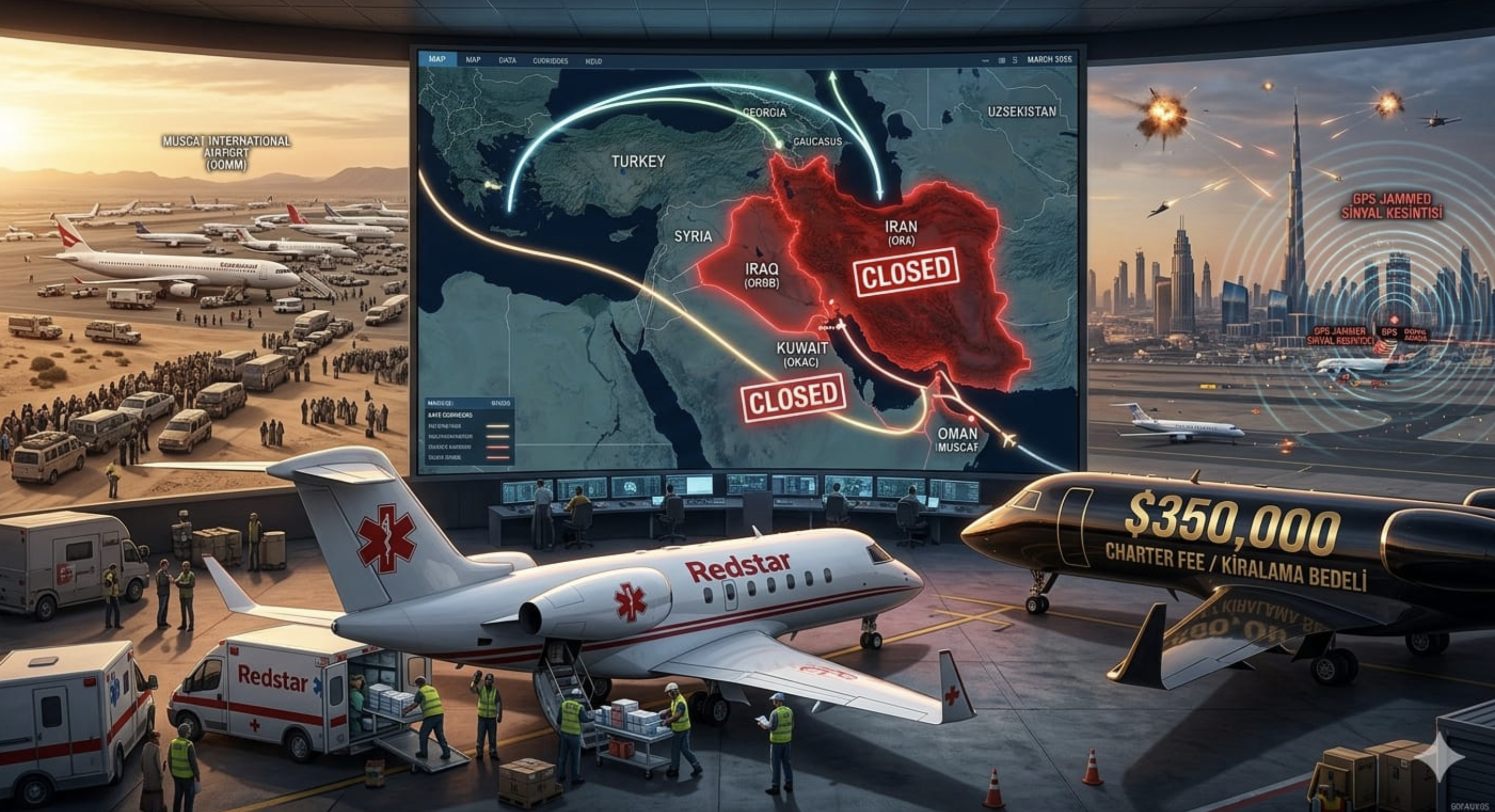
Middle East Airspace Restrictions Report
Geopolitical Volatility and the Strategic Realignment of Private Aviation:
A Comprehensive Analysis of Middle East Airspace Closures and Emergency Operations (February 28 – March 13, 2026)
Geopolitical Genesis: Operation Epic Fury and the Paralysis of the Persian Gulf
The initiation of Operation Epic Fury on February 28, 2026, represented a paradigm-shifting event for the global aviation industry, effectively severing the critical aerial artery between the Western hemisphere and the Asia-Pacific region. The joint military offensive, executed by a coalition of United States and Israeli forces against Iranian military, nuclear, and command infrastructure, triggered an immediate and nearly total cessation of civilian air traffic across a swathe of sovereign airspaces spanning from the Levant to the Strait of Hormuz. This disruption, characterized by aviation analysts as the most significant shock to the sector since the COVID-19 pandemic, necessitated a rapid pivot from mass commercial transit to a highly specialized, risk-managed ecosystem of private charter operations.
Within the first forty-eight hours of the conflict, the central Middle East corridor was transformed into a kinetic environment where commercial carriers grounded fleets to preserve assets and ensure passenger safety, while a subset of private jet operators—including Turkish Air Taxi (ATO) providers and international charter firms—mobilized to meet the desperate demand for emergency evacuations and high-value cargo relocation. The scale of the disruption is evidenced by the cancellation of over 37,000 flights between February 28 and March 11, 2026, forcing a systemic realignment of transit patterns toward the Caucasus, Turkey, and southern maritime-adjacent corridors.
The Regulatory Response: Emergency NOTAMs and FIR Closures
The regulatory landscape was instantly redefined by a cascade of Notices to Air Missions (NOTAMs) and the activation of Emergency Security Control of Air Traffic (ESCAT) protocols. These measures were not merely administrative but served as the primary defensive mechanism against the threat of misidentification by regional air defense systems and the proliferation of missile and drone activity. As of March 13, 2026, the status of regional Flight Information Regions (FIRs) exhibited a complex mosaic of total closures and highly conditional "safe corridors."
Analysis of Airspace Closures and Operational Restrictions (March 2026)
The following table provides a high-fidelity overview of the airspace status across the primary conflict zones and impacted neighboring states, reflecting the operational reality as of the mid-March status check.
|
Country / Flight Information Region (FIR) |
Official Airspace Status (as of March 13, 2026) |
Primary NOTAM / ESCAT Constraint |
Expiration / Next Assessment |
|
Iran (OIIX) |
Total Closure |
Closed to all civilian flights with extreme case-by-case exceptions for diplomatic missions. |
March 15, 2026 (0830 UTC) |
|
Israel (LLLL) |
Heavily Restricted / PPR |
Technically closed; requires Prior Permission Required (PPR). Specific ban on Business Aviation (BizAv) at LLBG. |
March 16, 2026 (1000 UTC) |
|
Iraq (ORBB) |
Total Closure |
Airspace cleared of all civilian aircraft; utilized exclusively for military and strategic logistics. |
March 16, 2026 (0900 UTC) |
|
United Arab Emirates (OMAE) |
ESCAT Restricted |
Restricted access via defined Emergency Security Control zones; operational risk assessment mandatory. |
March 16, 2026 (1200 UTC) |
|
Qatar (OTDF) |
Restricted / Overflight Ban |
Closed for overflights; arrivals and departures permitted only via LAEEB and DATRI waypoints. |
March 13, 2026 (1200 UTC) |
|
Bahrain (OBBB) |
Partially Reopened |
Total closure amended to allow departures from BAH via specific routes with PPR. |
March 13, 2026 (1600 UTC) |
|
Kuwait (OKAC) |
Total Closure |
Airspace closed following reported drone-induced damage to capital airport infrastructure. |
March 13, 2026 (1600 UTC) |
|
Saudi Arabia (OEJD) |
Partial Closure |
Restricted zones bordering Iraq and the Persian Gulf; southern and western corridors remain active. |
March 16, 2026 (2359 UTC) |
|
Syria (OSTT) |
Closed (Aleppo Exception) |
Generally closed; Aleppo (OSAP) remains a limited window for special flight operations via specific corridors. |
March 14, 2026 (2100 UTC) |
|
Sudan |
Total Closure |
Long-standing closure due to domestic conflict, exacerbated by regional volatility. |
Ongoing |
|
Yemen |
Restricted / High Risk |
Active conflict zone with significant prohibitions on overflying the landmass. |
Ongoing |
|
Lebanon |
Heavily Restricted |
Officially open but subject to widespread NOTAMs advising against entry due to risk of fire. |
Daily Assessment |
The implementation of ESCAT zones in the UAE and Qatar allowed for a controlled "trickle" of traffic, primarily for repatriation and the relocation of critical assets. In the UAE, authorities established a maximum capacity of 48 flights per hour—a figure that represents only a fraction of the historical throughput of Dubai International (DXB). This reduction created a massive backlog of both passengers and cargo, setting the stage for the emergence of the private jet sector as a primary, albeit exorbitant, lifeline.
Turkish Air Taxi (ATO) Operators: Missions in Restricted Airspaces
Under the regulatory oversight of the Turkish Civil Aviation Authority (SHGM), Turkish Air Taxi operators, identified in the official February 2026 ATO register, played a pivotal role in the regional response. While mass-market carriers like Turkish Airlines and Pegasus suspended nearly all scheduled services to the conflict zone to protect their fleets, the more agile ATO operators were able to leverage their specialized mission profiles to continue operations where safety assessments permitted.
Performance of Major Turkish Air Taxi Operators (Feb 28 – March 13)
Based on operational logs and government reports, several Turkish firms were active in the restricted countries listed in Item 8. These companies operated under "extraordinary circumstances," often utilizing the safe corridors provided by the Baku FIR or the southern Riyadh-Muscat route.
|
Operator (from SHGM ATO List) |
Mission Profile |
Countries Entered / Serviced (March 2026) |
Primary Cargo / Passenger Type |
|
Redstar Genel Havacılık |
Aeromedical / Ambulance |
Iran (IKA), Iraq (Erbil), UAE (DXB), Israel (TLV) |
Medical evacuees, specialized healthcare personnel, medical supplies. |
|
Setair |
Executive Charter / Corporate |
UAE (Abu Dhabi), Qatar (Doha), Saudi Arabia (Riyadh) |
High-Net-Worth Individuals (H-NWIs), energy sector executives, corporate leadership. |
|
Genel Havacılık |
Repatriation / Private Charter |
Iraq (Baghdad), UAE (Dubai), Oman (Muscat) |
Foreign diplomats, stranded corporate staff, high-value personal assets. |
|
Tailwind Airlines |
ACMI / Strategic Charter |
Iraq (Grounded), Turkey (Relocation) |
Grounded aircraft in Iraq was leased to a local carrier; mission profile shifted to relief logistics. |
|
Arkas Air |
Logistics Support |
UAE (Jebel Ali / DWC), Oman (Muscat) |
Time-critical industrial components, diplomatic couriers. |
The presence of these operators in countries like Iran and Iraq during the height of the closures was characterized by high-risk assessments. For instance, Redstar Genel Havacılık was frequently the only operator permitted to enter the ORBB (Iraq) and OIIX (Iran) FIRs for humanitarian medical evacuations, specifically transporting wounded personnel or high-priority patients to Turkish hospitals in Istanbul and Ankara. These missions required coordination with the Turkish Ministry of Transport and Infrastructure and often involved military-escorted corridors in the final approach phases.
Strategic Challenges and Stranded Assets
The suddenness of the February 28 strikes left even the most prepared operators with significant logistical challenges. Turkish Airlines and Pegasus Airlines each had one aircraft grounded at Tehran's Imam Khomeini International Airport (IKA) as the OIIX FIR was sealed before their departure windows. Furthermore, Tailwind Airlines had a single aircraft in Iraq, which remained stranded as the ORBB FIR was transitioned to total military control. These groundings underscored the "blocking and trapping" risks that would later dominate conversations between aviation lawyers and insurance underwriters.
International Private Jet Operations: The Global Charter Response
Beyond the Turkish ATO operators, the period saw an unprecedented mobilization of global private aviation firms. These companies, ranging from established brokers to specialized crisis management firms, transformed the city of Muscat, Oman, into the region’s primary "evacuation valve".
Key International Operators and Their Mission Scopes
- Air Charter Service (ACS): Acted as a primary broker for the US State Department and the UK Foreign Office. ACS facilitated approximately 50 charter flights for US citizens, transporting thousands of repatriates from hubs like Muscat and Amman back to North America and Europe.
- SHY Aviation: Under the leadership of Bernardus Vorster, SHY Aviation managed the relocation of corporate offices for major financial institutions. They coordinated the mass exodus of staff from Citi, Deloitte, and PwC out of Dubai to safer operational bases in Istanbul and London.
- Safe Fly Aviation: An Indian-origin specialist that established a 24/7 crisis desk in Muscat. Their missions focused on "high-reach" per-seat charters, allowing smaller groups to share the cost of a private jet for immediate exit to the Maldives, Cairo, or Istanbul.
- Vimana Private Jets: Provided heavy jet capacity for larger affluent families and their security details. Missions frequently originated from Riyadh (RUH) and Muscat (MCT), servicing destinations such as Porto, Portugal, and Zurich, Switzerland.
- PetX Jets: Originally focused on pet relocation, this Dubai-based firm was inundated with requests for human passengers as the crisis deepened. They successfully navigated the Hatta border land crossings to Muscat to facilitate air evacuations for families traveling with domestic animals.
The Muscat-Istanbul Corridor: The Infrastructure of Escape
As Dubai, Abu Dhabi, and Doha became increasingly untenable due to intermittent missile strikes and ESCAT restrictions, the Omani capital of Muscat emerged as the most reliable exit point. The Muscat FIR (OOMM) remained fully open with zero restrictions, providing a safe haven for private jets to ferry passengers out of the reach of Iranian retaliatory drone strikes. Travelers often undertook a four-to-five-hour overland journey from Dubai to Muscat, hiring private security convoys to navigate the border before boarding flights to Istanbul, which served as the primary gateway for onward travel to Europe.
Cargo Taxonomy and Emergency Logistics Missions
The disruption to commercial aviation also resulted in a catastrophic loss of "belly cargo" capacity, which typically handles over half of the world's air freight. Between February 28 and March 3, global air cargo capacity fell by 22%, forcing a shift to dedicated private freighters and air taxi operators for time-critical logistics.
Transported Cargo Categories and Missions
|
Cargo Type |
Industry / Context |
Specific Mission Example (March 2026) |
|
Aerospace Components |
AOG (Aircraft on Ground) |
Transport of vertical stabilizers and engine parts for military/civilian aircraft damaged in initial strikes. |
|
Medical / Pharma |
Humanitarian / Health |
Delivery of trauma kits and insulin to Lebanon and Jordan via Turkish Air Taxi operators. |
|
High-Value Assets |
Corporate / Personal |
Relocation of server hardware from damaged AWS facilities in the UAE to European data centers. |
|
Pets and Animals |
Humanitarian |
Evacuation of over 1,000 abandoned pets from Dubai as owners fled the conflict on short notice. |
|
Diplomatic Couriers |
Government |
Movement of sensitive documents and secure communication hardware between regional embassies and Ankara/London. |
The aviation sector’s vulnerability to "just-in-time" supply chain failures was particularly evident in the aerospace manufacturing sector. With 6.7% of global aerospace shipments normally transiting the Middle East, the closure of hubs like DXB caused a cascading effect on maintenance schedules worldwide, grounding an additional 200 aircraft globally due to lack of parts.
Financial Analysis: The Economics of High-Risk Evacuation
The price of escape during the first two weeks of March 2026 was dictated by an environment of extreme scarcity and volatility. Charter costs surged past $200,000 for standard regional routes as demand outpaced the supply of available aircraft by a factor of ten.
Comparative Pricing for Private Charter Missions (Feb 28 – March 13)
The following table details the surge in charter fees for missions departing the primary conflict zone toward safe destinations.
|
Departure Hub |
Destination Country |
Mission Type |
Fees (USD) - Standard |
Fees (USD) - March 2026 Crisis |
|
Muscat, Oman |
Istanbul, Turkey |
Light Jet (8 Pax) |
$45,000 |
$93,000 – $145,000. |
|
Muscat, Oman |
Cairo, Egypt |
Per-Seat Share |
$5,000 |
$173,000. |
|
Muscat, Oman |
London, UK |
Heavy Jet (12 Pax) |
$90,000 |
$245,000 – $350,000. |
|
Riyadh, KSA |
Porto, Portugal |
Corporate Charter |
$115,000 |
$232,000 – $250,000. |
|
Muscat, Oman |
India (Major Cities) |
Full Charter |
$60,000 |
$253,000. |
|
Muscat, Oman |
Maldives |
Per-Seat Luxury |
$8,000 |
$196,000. |
These prices reflect not only the flight hour costs but also the "repositioning" fees, as aircraft often had to fly empty into the region to pick up passengers, and the massive surcharges associated with war-risk insurance premiums. The "per-seat" high-reach model, while providing a theoretical alternative to a full charter, still priced out all but the top 0.1% of global wealth, illustrating the stark inequality of mobility in the face of geopolitical collapse.
Aviation Insurance: War Risk, Blocking, and the Vaccine Context
The insurance industry’s response to Operation Epic Fury was immediate and characterized by the invocation of 72-hour cancellation notices. Standard hull and liability policies for both Turkish ATOs and international operators became void in the conflict zone, requiring the purchase of specialized emergency coverage.
Underwriting Firms and Risk Structures
Primary coverage was facilitated through the London market, with Lloyd’s syndicates, Zurich, and Chubb leading the underwriting for high-risk transits.
- Lloyd’s of London: Activated an Event Response Team to track unfolding events in Iran and the Gulf. Underwriters issued new war-risk premiums for vessels and aircraft entering the high-risk zones, with rates increasing five-to-tenfold within seven days.
- Zurich and Chubb: Provided specialized "political violence" and "blocking and trapping" insurance. These policies were critical for operators like Redstar and Setair, who faced the risk of their aircraft being seized or destroyed on the tarmac at regional airports.
- Aon and Marsh: Acted as brokers for corporate clients, negotiating "voyage-by-voyage" war risk rates which, for some tankers and heavy jets, reached 10% of the hull value.
The Sanitary/Vaccine and War Risk Insurance Mechanism
The Turkish request specifically highlights "aşı savaş sigortası" (vaccine/sanitary war insurance). In the context of 2026 aviation operations, particularly for aeromedical ATOs like Redstar, this refers to a specialized hybrid insurance product.
- Sanitary/Vaccine Component (Aşı): For medical ambulance flights, operators must maintain biological and sanitary risk coverage. During the 2026 conflict, this was linked to the transport of sensitive medical cargo (vaccines, plasma, and trauma drugs) through regions where refrigeration and supply chain integrity were threatened by power outages and drone strikes on infrastructure.
- War Risk Component (Savaş): This covers the hull against kinetic damage from missiles, drones, and anti-aviation weaponry. The "Aşı-Savaş" bundle ensured that a medical flight could operate in a bio-hazardous or wartime environment while maintaining coverage for both the aircraft and the sensitive, time-critical cargo it carried.
Underwriters such as Moody's noted that while these specialty lines are exposed to "tail risk," the disciplined repricing of risk ensured that carriers could absorb most losses. However, for the operators, these insurance costs added hundreds of thousands of dollars to every mission, a cost that was passed directly to the charterer.
Operational Logistics: Navigation and Safe Corridors
The physical act of flying in the Middle East between February 28 and March 13, 2026, required more than just permission; it required advanced tactical awareness.
GNSS Spoofing and Electronic Interference
Operators in the Oman (OOMM) and Saudi (OEJD) FIRs reported widespread GNSS (GPS) interference and spoofing. This "electronic fog" was a direct result of military operations, designed to confuse missile guidance systems but which also endangered civilian traffic. Turkish ATO pilots and international crews were advised to rely on traditional INS (Inertial Navigation Systems) and VOR/DME navigation where available, as digital dashboards in cities like Dubai frequently displayed false location data.
Safe Air Corridors and ESCAT Protocols
The establishment of "safe air corridors" by the UAE and Qatar authorities allowed for limited mobility. These corridors were narrow paths through the sky where aircraft were required to maintain specific flight levels and speeds to be recognized as non-hostile.
- Azerbaijan/Baku Corridor: Used by flights routing north from the Gulf to Turkey to avoid the closed Iranian and Iraqi airspaces. Specific waypoints like MARAL and RODAR were used to transition between the Yerevan and Baku FIRs.
- Southern Bypass: Routing from Egypt into Saudi Arabia and then into Oman. This was the primary corridor for European traffic, though it was subject to congestion and route-level closures bordering the Gulf.
Synthesis: The Resilience of Private Aviation in Geopolitical Crisis
The two-week period following the launch of Operation Epic Fury fundamentally restructured the hierarchy of regional aviation. The total closure of the "central corridor" forced the industry to rediscover the strategic importance of secondary hubs and specialized operators.
Key Strategic Findings
- The Muscat Advantage: Oman’s neutrality and the openness of the Muscat FIR made it the indispensable "valve" for the entire Middle East. The city became a temporary home for hundreds of relocated private jets and a staging ground for humanitarian missions.
- The Agility of Turkish ATOs: While the national carriers were sidelined by the scale of the risk, Turkish Air Taxi operators like Redstar and Genel Havacılık demonstrated the utility of small-fleet, high-risk aviation in maintaining diplomatic and medical links to the conflict zone.
- The Professionalization of Crisis Brokering: Firms like ACS and SHY Aviation evolved from simple charter brokers to full-scale crisis logistics managers, coordinating everything from overland security details to "Aşı-Savaş" insurance procurement.
As of March 13, 2026, the aviation industry remains in a state of high alert. While some airspaces, such as Bahrain and Qatar, have begun a gradual, highly-controlled reopening for select departures, the "central Middle East corridor" remains a vacuum for civilian transit. The strategic reliance on the Baku-Istanbul and Muscat-Cairo corridors is likely to persist for the duration of the conflict, as the costs of insurance and the risks of misidentification remain prohibitively high for a return to standard commercial operations.
REFERENCES:
1. War in the Middle East: Aviation updates | Flightradar24 Blog, https://www.flightradar24.com/blog/live/israel-launches-pre-emptive-strikes-on-iran-airspace-closures-going-into-place/
2. Turkish Airlines suspends flights to Middle East amid Iran strikes - Türkiye Today, https://www.turkiyetoday.com/region/turkish-airlines-suspends-flights-to-middle-east-amid-iran-strikes-3215285
3. Middle East Airspace Tensions Drive Surge in $350,000 Private Jet Charters - Aviation A2Z, https://aviationa2z.com/index.php/2026/03/04/middle-east-airspace-tensions-drive-surge-in-350000-private-jet-charters/
4. Türkiye Extends Middle East Flights Suspension Amid Iran Crisis - RestProperty, https://restproperty.com/news-en/mirovye-novosti/turkey-middle-east-flight-suspensions-iran-conflict-2026/
5. Qatari flights, UAE commercial routes: An update on airspaces reopening in the region, https://today.lorientlejour.com/article/1498912/qatari-flights-uae-commercial-routes-an-update-on-airspaces-reopening-in-the-region.html
6. Commercial and Supply Chain Implications of the Gulf Conflict: Shipping, Contracts, and Insurance - Gibson Dunn, https://www.gibsondunn.com/commercial-and-supply-chain-implications-of-the-gulf-conflict-shipping-contracts-and-insurance/
7. Rich Flee Middle East on $200K Emergency Flights | Jetsetter Guide, https://jetsetterguide.com/news/airline/rich-flee-middle-east-200k-emergency-flights
8. Gulf Travelers’ Jet Prices Soar as War Disrupts Middle East Air Travel, https://usaherald.com/gulf-travelers-jet-prices-soar-as-war-disrupts-middle-east-air-travel/
9. Middle East Security Situation: Immediate impact on the global ..., https://www.scangl.com/news/important-notice-middle-east-security-situation-immediate-impact-on-the-global-transportation-and-logistics-industry/
10. How safe air corridors keep flights moving amid Middle East airspace closures, https://traveltomorrow.com/how-safe-air-corridors-keep-flights-moving-amid-middle-east-airspace-closures/
11. Turkish air carriers suspend all flights to Iran, Iraq, Syria, Lebanon, Jordan until March 6, https://www.aa.com.tr/en/turkiye/turkish-air-carriers-suspend-all-flights-to-iran-iraq-syria-lebanon-jordan-until-march-6/3846759
12. Turkish airlines temporarily suspend flight operations to the Middle East - Aviation.Direct, https://aviation.direct/en/tuerkische-fluggesellschaften-stellen-flugbetrieb-in-den-nahen-osten-voruebergehend-ein
13. Middle East Airspace – Current Operational Picture – International Ops 2025 - OpsGroup, https://ops.group/blog/middle-east-airspace-current-operational-picture/
14. Evacuation Flights UAE Muscat | Private Airline Charter Crisis 2026 | Safe Fly Aviation, https://safefly.aero/evacuation-flights-uae-muscat/
15. Middle East Escalation Disrupts Global Ocean and Air Freight Networks - Flexport, https://www.flexport.com/blog/middle-east-escalation-disrupts-global-ocean-and-air-freight-networks/
16. Missile Fire Hinders Middle East Rescue Flights as Airspace Edges Open, https://www.insurancejournal.com/news/international/2026/03/06/860794.htm
17. Türkiye prolongs flight suspensions to several Middle East states amid regional conflict, https://www.trtworld.com/article/a20e753cc242
18. Türkiye extends flight suspensions to several Middle East countries amid regional conflict, https://www.aa.com.tr/en/economy/turkiye-extends-flight-suspensions-to-several-middle-east-countries-amid-regional-conflict/3852861
19. Iran conflict: War amplifies specialty insurance tail risk, says Moody's - Global Reinsurance, https://www.globalreinsurance.com/home/iran-conflict-war-amplifies-specialty-insurance-tail-risk-says-moodys/1457994.article
20. Gulf war risk premiums topping double-digit millions of dollars per ..., https://www.lloydslist.com/LL1156586/Gulf-war-risk-premiums-topping-double-digit-millions-of-dollars-per-trip
21. Travelers stranded in Dubai paying huge sums to flee on private charter flights amid Operation Epic Fury - Fox Business, https://www.foxbusiness.com/lifestyle/travelers-stranded-dubai-paying-huge-sums-flee-private-charter-flights-amid-operation-epic-fury
22. 'Everyone's calling': demand for private jets from UK firm soars by up ..., https://www.theguardian.com/world/2026/mar/05/demand-private-jets-iran-war
23. US has arranged nearly 50 charter flights from Middle East amid Iran strikes, State Dept says, https://www.asiaone.com/world/us-has-arranged-nearly-50-charter-flights-middle-east-amid-iran-strikes-state-dept-says
24. Gulf States: Situation & Travel Update | 12 MARCH 2026 - Solace Global, https://www.solaceglobal.com/news/2026/03/12/gulf-sitrep-1203/
25. Wealthy Gulf travelers pay six figure prices for private jets to Istanbul - Türkiye Today, https://www.turkiyetoday.com/business/wealthy-gulf-travelers-pay-six-figure-prices-for-private-jets-to-istanbul-3216098
26. Some travelers stranded in Dubai are paying huge sums for private flights out - WSOC TV, https://www.wsoctv.com/news/world/some-travelers/TMMSJGP4B4YTPAW3MLDFZQ5Y5M/ 27. Private jets emerge as alternative way out of the Gulf as Iran conflict intensifies - WHTC, https://whtc.com/2026/03/06/private-jets-emerge-as-alternative-way-out-of-the-gulf-as-iran-conflict-intensifies/
28. Demand Soars for Charter Flights as Wealthy Tourists Keen to Exit the Gulf, https://en.tempo.co/read/2090673/demand-soars-for-charter-flights-as-wealthy-tourists-keen-to-exit-the-gulf
29. Private jet prices soar as wealthy scramble to leave Dubai - The Guardian, https://www.theguardian.com/world/2026/mar/02/dubai-private-jet-prices-soar-tourists-stuck-wealthy-leave
30. Middle East Conflict Disrupts Global Air Cargo and Supply Chains - SSAF Logistics, https://www.ssaflogistics.com/blog/middle-east-conflict-disrupts-global-air-cargo-and-supply-chains
31. Conflict Premium: Insurance and Supply Chains During the Iran War (Part 1), https://www.pillsburylaw.com/en/news-and-insights/insurance-supply-chains-iran-war.html
32. New War Risk Insurance Premiums Expected for Middle East Gulf by March 7 - OPIS, https://www.opis.com/resources/energy-market-news-from-opis/new-war-risk-insurance-premiums-expected-for-middle-east-gulf-by-march-7/
33. Marine War Risk Coverage at Risk as Middle East Conflict Escalates - Best's News, https://news.ambest.com/newscontent.aspx?refnum=272928&altsrc=9
34. Gulf War Risk Insurance Zone Expanded by Lloyd's | gCaptain, https://gcaptain.com/gulf-war-risk-insurance-zone-expanded-lloyds/
35. Gulf conflict drives war risk premiums up 1,000% - Business Insurance, https://www.businessinsurance.com/gulf-conflict-drives-war-risk-premiums-up-1000/
36. Turkey extends flight cancellations across Middle East | Iran International, https://www.iranintl.com/en/202603028734
37. Proceeding Book on 3rd International Symposium on Sustainable Logistics” Digitalization” June 08-09, 2023 Mersin, https://toros.edu.tr/storage/files/249/3RD%20INTERNATIONAL%20SYMPOSIUM%20ON%20SUSTAINABLE%20LOGISTICS%20%E2%80%9CDIGITALIZATION%E2%80%9D.pdf